3 A Stairway to Heaven
3.1 Building Objects
The function to create objects in miner is the setBlock function. It expects four arguments, the first three being the coordinates of your item’s location, and the fourth being the block_id you want to set. An optional argument is block_style.
We first load the miner package.
First, you need to find out where you are, and before we do that we need to figure out who we are. You can use getPlayerIds to get the ids of all players currently in the Minecraft world. You can use the getPlayerPos function to find the position of each player. If you are the first player, you can pull your ID as the first element of the object returned by getPlayerIds:
3.2 Stairway to heaven
We will create a matrix that contains our increments. First we create
a matrix with as many columns as we want stairs, and three rows
specifying our coordinates. The coordinates are obtained by
incrementing the first and second element of each column. We then use
apply to pass each column to the setBlocks function.
# get your position
pos <- getPlayerPos(my_id, tile = TRUE)

# shift the position slightly,
#   so the stairs aren't right on top of you
pos <- pos + c(1, 0, 1)

# number of stairs to create
n_stairs <- 10

# matrix to contain stair locations
# first repeat the start position a bunch of times
stairs <- replicate(n_stairs, pos)

# for all but the first stair, move over and up one
# this is position relative to previous stair
upset <- cbind(rep(0, 3), replicate(n_stairs - 1, c(1, 1, 0)))

# for each row, use cumsum to get position relative to first stair
#    then transpose so that the result still has 3 rows
upset <- t(apply(upset, 1, cumsum))

# get final positions and transpose
#   now rows are stairs and columns are coordinates
stairs <- stairs + upset
We’re almost ready to add our stairs, but first we need to get the item ID for oak wood stairs.
##                name id style
## 120 Oak Wood Stairs 53     0
Okay, so now we can add our stairs, using id=53.
Here is an example of the resulting stairway:
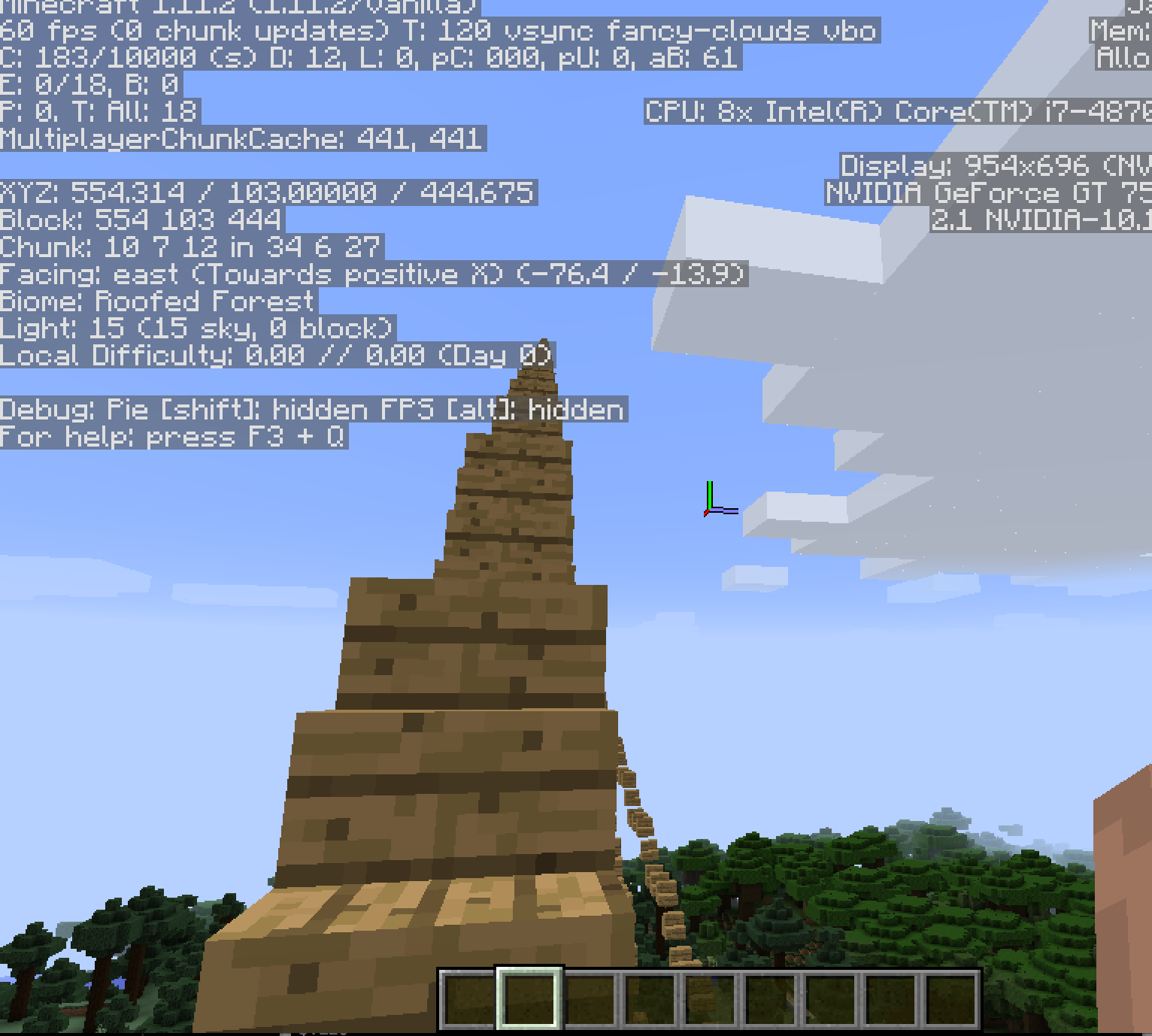
We can call that last command a couple of more times, with shifts in the last coordinate, to make an extra-wide, luxurious set of stairs.
apply(stairs, 2, function(x) setBlock(x[1], x[2], x[3]+1, id = 53))
apply(stairs, 2, function(x) setBlock(x[1], x[2], x[3]-1, id = 53))
Note: check out the function buildStairs() in the
craft package, which implements
this feature, building stairs going either down or up, in the
direction that a player is facing.